Tag Archives: writing

How to pitch the Guardian, Independent, Daily Mail etc.

So, a couple of weeks ago I sent a pitch to the Guardian. Despite casually dropping, “Oh, used to write for the Guardian …” into any conversation I’ve ever had, I haven’t written that much for the Guardian. But I have written for the Guardian before. A few times. I just want to make that clear.

Anyway, here’s the pitch I sent to Ann Lee, commissioning editor for G2.

….

To: annlee@guardian.co.uk

From: steve@stevewriteswords.com

Date: Aug 6th 2026

Hi Ann,

Like no doubt many others, I was pleased to see that the UK government is bringing in walk-in mental health hubs (in banks, libraries etc.) for those experiencing mental health conditions.

As the BBC reported yesterday:

Ministers have set out plans to create a network of nearly 200 community mental health centres and mental health A&Es by 2029.

The aim is to give those experiencing a mental health crisis or significant distress somewhere to go to get help when they need it – with plans to open dozens of the hubs in high street locations like banks and libraries.

One in five people struggle with their mental health and thousands of people turn up at A&E when they get to crisis point because they cannot find help elsewhere.

My slight quibble with this is that it feels a bit too late for me. 

When I was nineteen I started getting panic attacks and visual distortions and would hear voices, particularly at nighttime. 

This, as you might expect, terrified me. And I carried that terror around with me for a year or so and watched in horror as these symptoms worsened. Finally, I plucked up the courage to see my GP. (I was worried about getting sectioned – or worse.) 

My GP’s advice?

“What you need is a long walk on the beach.”

And so began a long, steady march towards decades of mental health problems. I’ve been diagnosed with a bunch of different mental health conditions – C-PTSD, BPD, and depression among them – and have experienced disorders as varied as exploding head syndrome (about as bad as it sounds) but nothing has quite stuck. 

In fact, I’m pretty much a normal, buoyant, functioning member of society now. But I often wonder how my 20s, 30s and 40s might have looked if I’d had better mental health care at those critical times as an adolescent. 

I’d have probably drunk a bit less and worked a bit more. I’d have paid more taxes. Maybe I’d have kids and a driving licence and a permanent place to live. Perhaps I wouldn’t have scythed through relationships so readily. 

Anything in this? Do you think there’s something in using this personal experience as a jumping off point to explore the benefits of these in-the-pipeline mental health hubs? I have a handful of GPs, psychologists, mental health professionals and kindred spirits I could call upon at the drop of a hat for quotes etc. 

I’ve written for the Guardian before on mental health here, and about my life as a semi-professional poker player here, where I also detailed my unravelling mental health. I’m honestly tons better now. 

And, also honestly, I feel these mental health centres are a brilliant, much-needed initiative. 

Many thanks for reading Ann,

Steve

Hi Ann. Many thanks for reading Ann. What a creep.

Anyway, here’s what Ann replied:

” “

Yep, nothing. Crickets. So I gave it a few days and tried TWO editors at the Independent. Here’s what they said:

” “

Same thing. In a fit of a pique – because, you know me, I can often get piquey – I tried the Daily Mail. Same thing. Or rather: same nothing.

Yet I’m not that fussed. It’s taken me a long time to realise this but I love pitching. And I love the world. I love pitching the world! And, yes, there have been one or two bumps in the road since I launched this back in 2009 but I’m more convinced than ever that I’m going to be a famous writer.

Famous writer. I sound like a five-year-old girl. But it’s true. I feel like I’ll get there. Despite AI. Despite the ghosting. Despite all of this, whatever all of this is. All of that, and all of this, is going to propel me to exactly where I want to go, probably.

[ENDS]

I went viral on LinkedIn and I don’t know if I liked it

So, the Saturday before last I was lying in bed drinking tea and reading the Financial Times Weekend Magazine. The FT Weekend edition, including the supplements, is probably the best newspaper in the world. And for a while now, I’ve been going through the FT Weekend in the hope of finding interesting, funny ads for my swipe file. But it’s been thin gruel. Most of the ads in the FT Weekend have mental health problems.

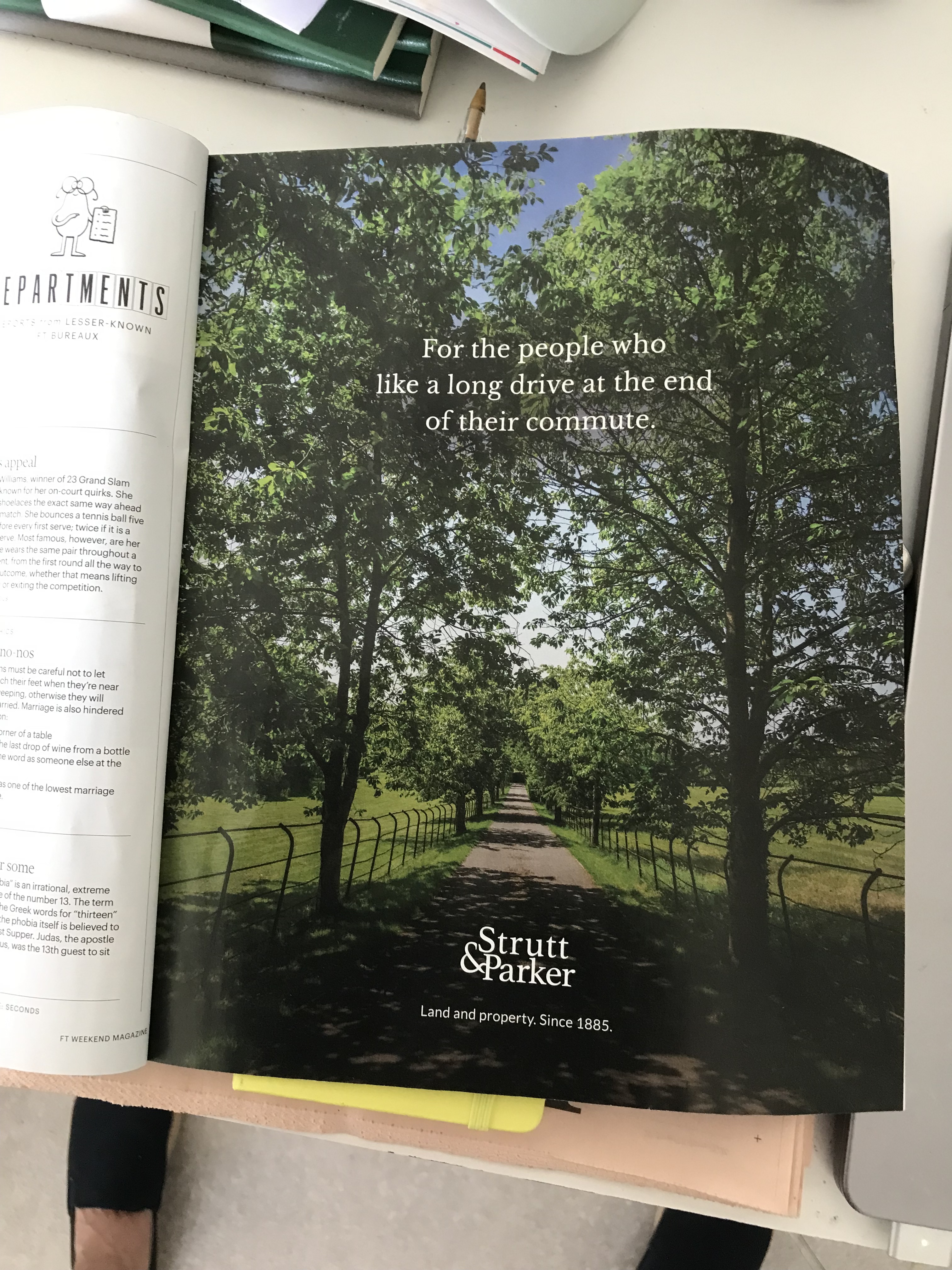
Yet this weekend was different. I spotted something that I actually really liked. It was an ad for an upmarket estate agency featuring a tree-lined, luxurious looking driveway, presumably swooping up to a house, with the line, ‘For the people who like a long drive at the end of their commute.’

See, look, I’m not lying.

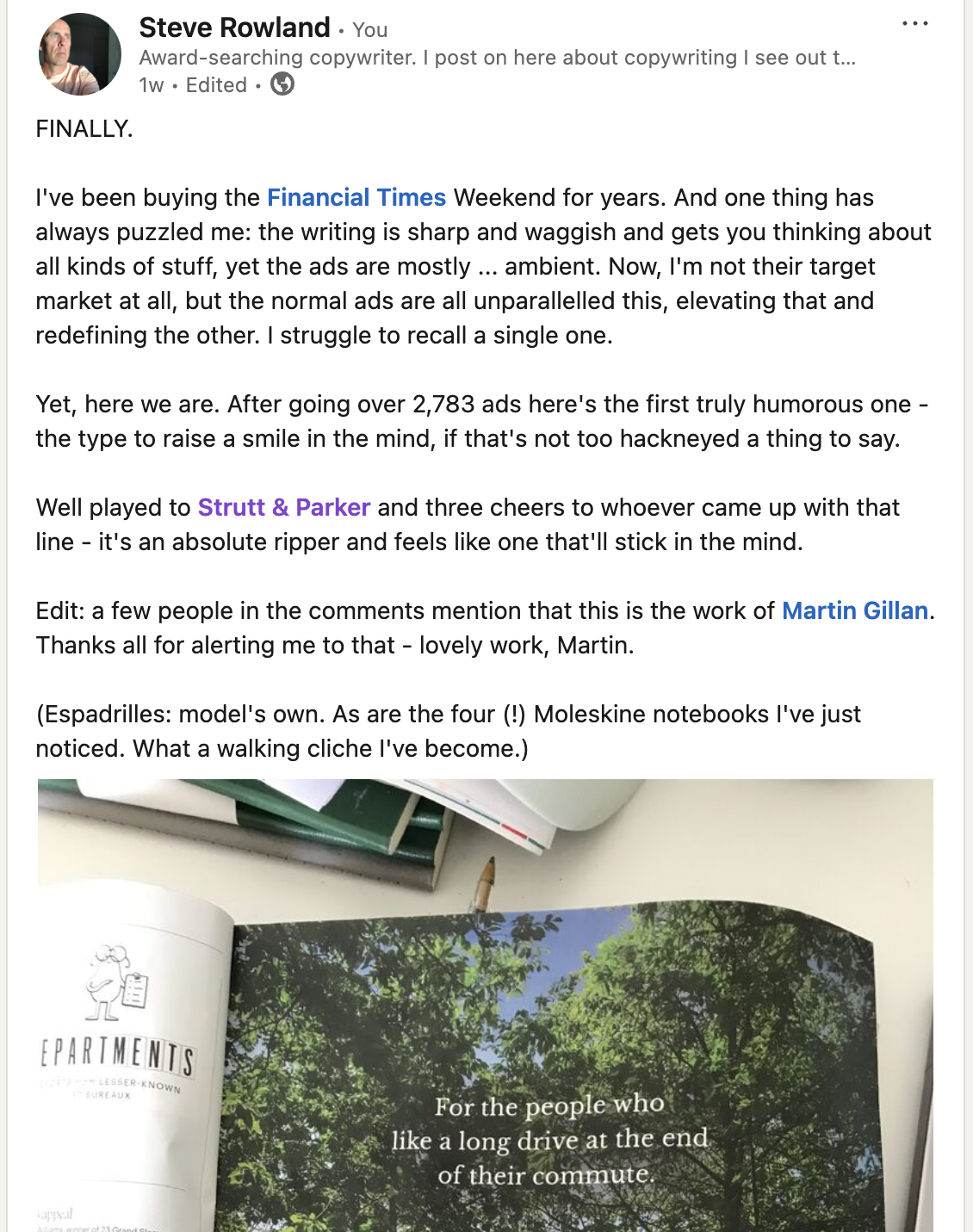
It’s good, isn’t it? Anyway, I posted a few short paragraphs on the ad, uploaded it to LinkedIn, went off to Milford on Sea music festival for the afternoon, and promptly forgot about it. (Forgot about the post, I mean, not the afternoon.)

Here’s what I wrote.

Like I say, I pretty much forgot about it. But the following morning, Sunday, I checked my email account. More emails than normal. And not just junk emails, actual people were actually asking me to connect. This was new. Rarely do people want to connect with me. But people had seen my post, liked it, and commented on it.

I went over to my LinkedIn account and saw my post had something like 15,000 views and a hundred or so reactions.

This immediately made me a bit giddy. And the giddiness continued as I replied to comments, edited the post to credit the writer of the ad, and watched the number of views, reactions and comments balloon. Once it got to about 25,000 views (which LinkedIn calls impressions), I wondered if I might be on the verge of going viral.

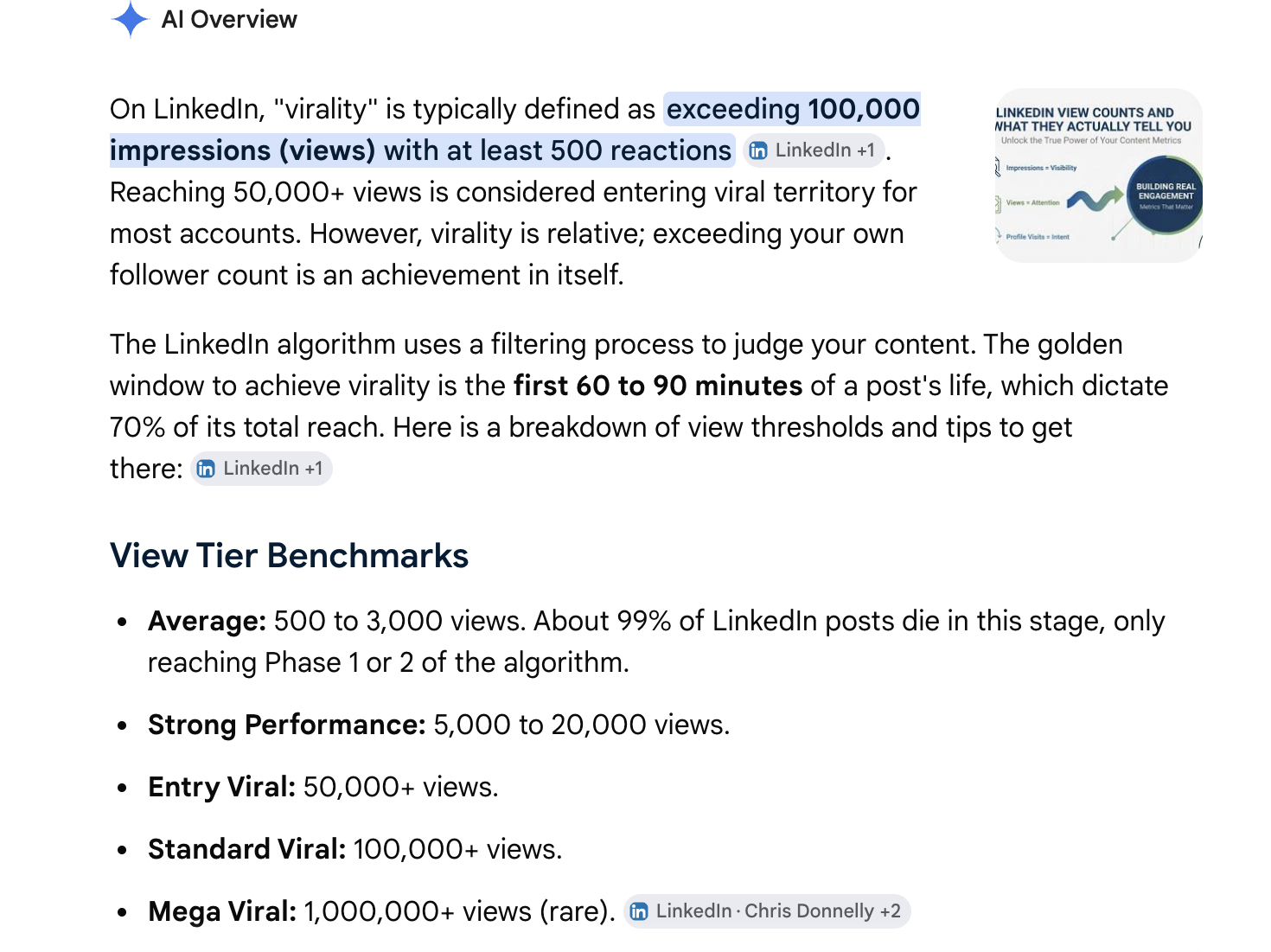
When you search ‘how many views are classed as going viral on LinkedIn’, here’s what you get.

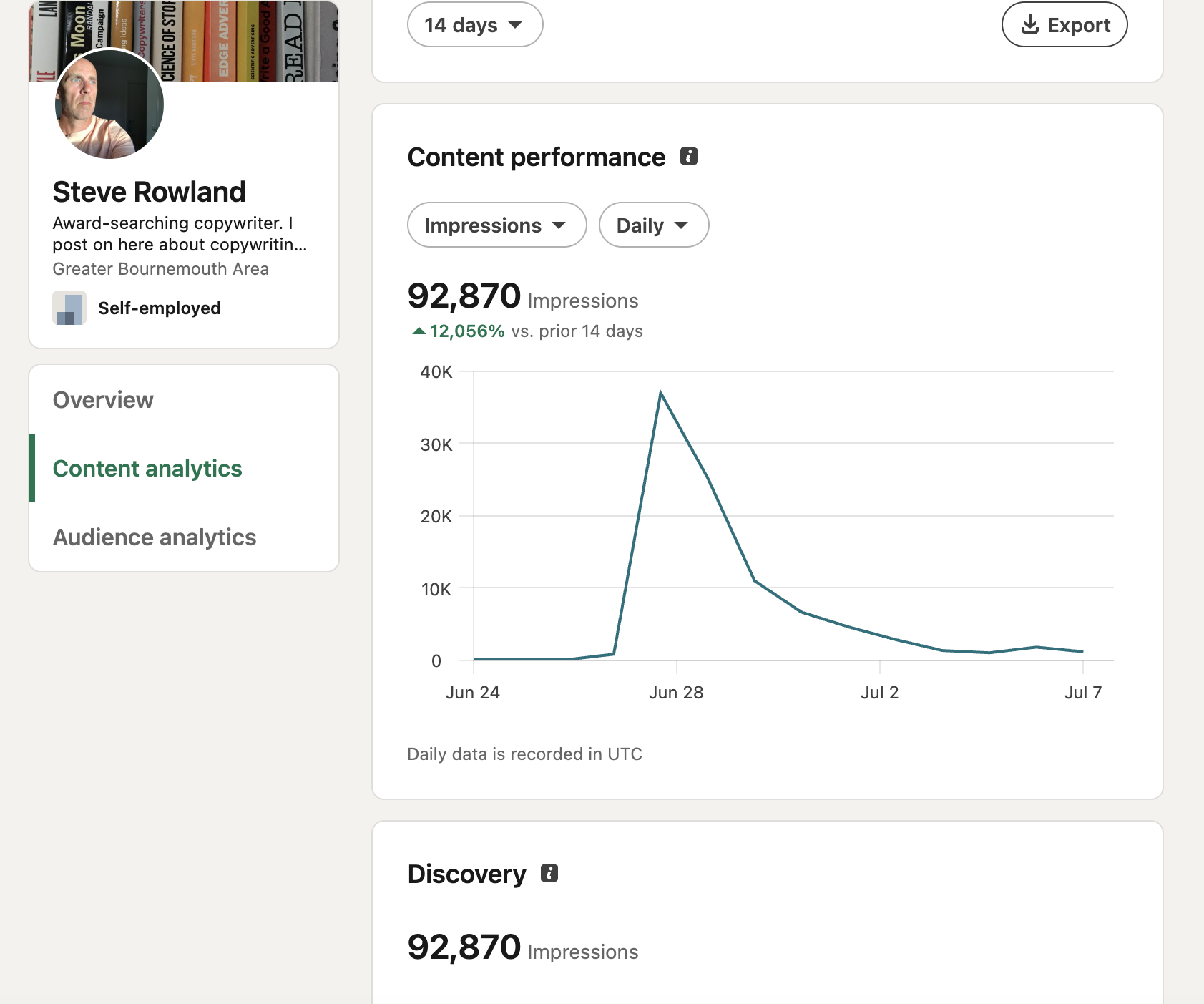
So it seems on that Sunday I was about halfway to entering ‘viral territory’. By the end of Sunday I had 36,901 views. The following day, Monday, I got a further 25,169 views. Tuesday 10,926. And so on. It looked a bit like this:

In fact, it didn’t look a bit like that, it looked a lot like that because that, above, is that – my impressions graph. At the time of writing I have nearly 93,000 impressions for that post. If I manage to get 7,000 more, I go from ‘entry viral’ (50,000 views) to ‘standard viral’ (100,000 views).

Yet I’m not sure how much I’ve liked it. I’ve enjoyed almost doubling my follower count and my new connections seem sound but the whole experience made me feel slightly unbalanced.

One reason I don’t like it, is because it’s not really my work. Okay, I provide some commentary on the ad but I didn’t create the ad. It wasn’t about me. I always felt that Pitching the World would be the making of me, that someone would swoop in – much like the way a driveway swoops in – and rescue me. Wouldn’t that be nice? Wouldn’t you like that? Someone swooping in, driveway-like, and rescuing you? Of course you would, we all would. I thought that would happen with one of my posts, that one would go viral and I would be showered with praise and money and love and then, if I’m lucky, maybe even some more money and love.

But the way that I reacted to going viral – and not even full viral, more homeopathic viral – on LinkedIn suggests that I’m not cut out for going viral anywhere. For a day or two I couldn’t get anything done. I just metronomically checked my Notifications to see who else was lying at my feet while feeding me grapes. In fact, I’ve just done it now, some eight or nine days later, and saw that I had a new reaction.

See, if you’re obsessed with monitoring your fame, you reach this kind of stasis. Which is a real shame. Because I don’t want to reach a kind of stasis, I want to get stuff done. I love getting stuff done. You know those times, as a freelancer, where you can spontaneously take the day off and go to the cinema, or spend a day lying in a park, while patting yourself on the back? Great, isn’t it? That’s me. But at the moment that’s me every day. And the allure soon wears off if every day is some syrupy indulgence – because if every day you can be spontaneous and skip through parks, or sit in a darkened cinema with four other bald men with their sandwiches, it just means that you don’t have any work.

Which is sort of me now. I can cope with not having any work, I’ve not had work lots of times. And, somehow, I’ve always been okay. But I do have a big list of things I want to do, like become a leg model. I’m sure there are other things. But you should really see my legs these days because my legs these days are something else, something other than ordinary legs. They’re the legs of a god. I walk miles in sand and hours up hills and then I oil them (the legs, not the hills) with Malibu fast tanning oil from Savers and think that, yes, although they are legs they are also something else, something otherworldly.

    Malibu tanning oil (with beta carotene), earlier.

    Look, it’s time we stopped all this. There are other things that I want to write about this experience, like how going viral-ish has made me gunshy, that I don’t want to disappoint my eager new followers and so I can’t post anything else at all at the moment, but this has been going on for ages, this post, and I really need to do things that include not writing this post. But I will try to become a leg model, just you wait and see. And I will also stop checking my LinkedIn notifications and become much more productive. Just you wait and see that as well.

    If you want to follow me or connect with me on LinkedIn then go here:

    https://www.linkedin.com/in/steve-rowland-85b423208

    I’d like that, a lot. If I don’t respond right away then I’m doing okay. If I do get back to you right away, send help.

    Pitching The Guardian

    Turns out I’m a big, fat liar.

    Last time out, when I was writing about pitching The Drum, I said something like, “This is the first pitch I’ve sent in years.”

    But then I remembered it wasn’t. See, a biggish thing happened to me last year. And I wanted to write about that biggish thing on here.

    Thing is, when you’re writing about biggish things it’s easy to become foggy and mawkish. Plus: it’s still a bit raw.

    A pitch on the other hand … I have no problem with posting a pitch about biggish things that have happened to me.

    So here you go.

    …………………

    To: Andrew Gregory @TheGuardian; Barbara Speed @The Guardian

    From: Pitching the World

    Date: Apr 29, 2024

    Subject: Post mini-stroke support is lacking – and alarming

    Hi Barbara and Andrew,

    First, huge apologies for the double-pitch. I didn’t know where this might be best suited – Opinion or Health. (It’s no excuse, really, but I’ve been out of the freelance journalism game for a while.)

    Second, I feel like I have a decent feature brewing. 

    Rageh Omaar had a suspected (by some) mini-stroke at the end of last week while hosting News at Ten and carried on. The week before that, I had a mini-stroke while playing tennis and also carried on. For about five games. Then I had to stop and go to the hospital in an ambulance with blue, flashing lights.

    The incident was scary. I couldn’t speak properly. Plus: numb tongue, numb right side of my face, a numb right arm and numb right leg that wouldn’t really function. In hospital they tell you that you’ve had a mini-stroke – that bit is scary, too – and put you through all sorts of machines and do all manner of tests before popping you on statins, BP-lowering medication and anti-platelet medication before sending you home. 

    But if the mini-stroke is scary, the landscape you face when you come out is scarier. I’m a reasonably fit, reasonably active, reasonably happy and reasonably middle-aged (48) writer. Yet I came out of the hospital worried. Worried that pushing too hard at work caused the stroke and that I might need to work at half the pace or – worse – give up work altogether. Worried that I’d have to move out of my flat. Worried that my life would unravel (again). 

    Most of all, I was (and am) worried that I might have another stroke. I’ve seen some stats suggesting that almost one in three TIA survivors will go on to have a major stroke within a year. Some studies say that 11% of those who experience a TIA will have a bigger stroke within a week

    The figures are hazy – and change from paper to paper and study to study. Yet the underlying reality is that TIAs are a warning and often signal a bigger stroke is on the way. So why is the after care so poor? Why are you sent from hospital with a follow-up appointment in six weeks’, a bag of drugs, and not much else? Why, with stroke being such a major cause of death and disability in the UK, are we not doing more to support those who have experienced a TIA – particularly in the first week or two?

    And it doesn’t have to be massive help. Maybe some information on getting back to work, what you should and shouldn’t be eating, how often to exercise, how to deal with these blobs of depression and suicidal ideation. A number to call. A GP to chat with. That kind of thing. 

    I’m really blathering, aren’t I? Sorry about that – it’s been a tricky couple of weeks. Anyway, anything in this, do you think?

    Thanks for reading, cheerio for now,

    Pitching the World

    …………………

    Updates on what happened with that pitch – and what happened to me after April – when I have the stomach for it.

    April, earlier

    What’s this? An actual pitch? To the actual Drum?

    Turns out that being a best-selling author isn’t all it’s cracked up to be. After becoming a best-selling author, things went a bit wrong. Well, actually, things went a lot wrong. Life, eh? Look at it: going a lot wrong and that.

    Anyway, that’s perhaps for another time. (You know, what’s been going on for the last seven years and how things went a bit – A LOT – wrong.) 

    In the meantime, I actually wrote an actual pitch. My first one in years.

    ………………………………………………………………………………………………………….

    To: Gordon Young @ The Drum

    From: Pitching the World

    Subject: I’m elevating this robust pitch, Gordon, with impactful writing solutions

    Hi Gordon,

    Sorry to email you out of the blue like this but I think I have something that might fit for The Drum. 

    What if marketing-speak isn’t as bad as we think it all is?

    So, in the advertising and marketing world we all can’t bear marketing speak, right? We’re sick of it. I know, as a jobbing copywriter, that I am. But as one of only a handful of copywriters in the UK who run their own experiments into the effectiveness of language* I didn’t want to just say it. I wanted to prove it. 

    The idea? Take two pieces of text, both saying the same thing, but have one crammed with marketing-speak (‘unleash’, ‘innovative solutions’, ‘robust’ … you get the picture, I’m sure) and the other in well written plain-speak. My hypotheses? Plain-speak would trounce the marketing-speak. I ran them both through readability calculators and tested them out on an LLM (‘Is this writing clear?’ ‘Is this writing memorable?’ ‘Is this writing likely to be acted upon?’) and the plain-speak version shone brightly. Readability calculators loved it. LLMs loved it. And both hated the marketing-speak version. So far, so predictable.

    Next, I tested out on the public – specifically through Prolific. I thought I’d have my suspicions confirmed – that there would be howls of protest, that participants in the study would loathe the marketing-speak version, that the overexposure and overuse of these words would have caused some sort of semantic bleaching and readers would find marketing-speak lazy, cliched, tired, foggily obscuring the message and a whole heap of other bad things.

    But that didn’t happen. In fact, people preferred marketing-speak over plain-speak. So I ran my smallish pilot again. Same results. I cartoonified the language further, stretching it to ridiculous proportions – “Unleash more sales solutions” – and still the same thing. Overwhelmingly there was a feeling that marketing-speak sounded more ‘dynamic’ and ‘smarter’ and ‘more sophisticated and professional.’ 

    Anything in this, Gordon? As copywriters, marketers and ad people we assume that the public are as tired as we are of the seemingly trite sentiments of marketing speak. But what if the truth is different from that? What if we – collectively – have to get out of our bubbles a bit more? (I’m saying this as someone who loves Japanese selvedge denim and Picasso t-shirts as much as the next person.) To actually, you know, go out and test out some of this stuff rather than making assumptions. There’s maybe even room to explore if a conversational tone of voice is all it’s cracked up to be. I’ve read studies and papers showing that, actually, there are some circumstances where a corporate TOV fits much better …

    This is my first pitch in years. I know, I know: IT’S WAY TOO LONG. Sorry about that. If it’s not a good fit I have other places in mind but The Drum felt like a good home for it. I’ve got plenty of clipping from my time writing features for broadsheets and magazines and hundreds of columns and reviews if you’d like to see any published work. 

    Many thanks indeed,

    PTW

    *You know what, I don’t know if this is true – but I do know that it feels true.

    ………………………………………………………………………………………………………….

    A drum, earlier

    Gordon, who’s the editor of The Drum, got back to me within an hour or two. “Wow,” he opened, “sounds sensational.” And went on to tell me that he passed my pitch on to John, The Drum’s Opinion editor. 

    So, that’s a thing that happened. I sent a pitch and got a reply to a pitch. Who knows where that might go. 

    And who knows where I might go. Nowhere, hopefully. I’ve missed this place like the dickens. But I also know that I have certain … proclivities. 

    Thanks for reading.