On September 18th of this year I wrote: “For me, freelance journalism is tough at the moment. Anecdotally, freelance journalism is tough at the moment. I’ve heard of a handful of people in the last week alone who have either given up or are on the verge of giving up. Rates are low and dropping. Editors make you fuck them in bins and buy them hats before they commission you. Accounts departments spend all their time laughing and masturbating at you. All very grim and seedy, I’m afraid.”
For the record, I have never made love to an editor in a bin. I may, however, buy the next editor who commissions me a really nice hat. Bear that in mind, editors.
Anyway, rates. I’ve been promising to write about rates for some time now and I’m the sort of person who, if they promise to deliver something, they damn well deliver it. Please don’t write in saying this is not true. I know it’s not true.
Until a day or so ago, I thought that if I did write a post about rates, I would illustrate it with graphs. I imagined the graphs would look something like this:

After some digging around, I’m not sure how accurate that graph is, not sure to what extent ‘we in trouble’. Things could be a lot better, granted, but after seeking and receiving the advice from a couple of dozen journalists and editors over the last few days, I’m actually feeling more positive about being a freelance journalist than I have done all year.
In fact, I’m feeling a bit like this:

This man pops up if you type ‘online graphs’ into Google image search. He looks okay, he looks happy enough with things. Who is he? Maybe he’s reading this. If he is reading this, perhaps he could inject his opinion into this borderline laborious post. In the meantime, here are ten (later changed to eleven) things that I’ve found out about current freelance rates for journalists.
(Non-journalists/everyone may want to skip to the end, as I have a feeling I may put up another graph decorated with fuck words and dicks.)
1. Rates may well have stagnated over the last decade or two. According to Mari Molid*: “A friend of mine who’s freelanced forever says that the dirty little secret about freelance journalism is that rates are the same as 20 years ago. But our grocery, fuel and housing costs are sadly not.” Ida Alstad* seems to support this: “Some rates haven’t changed much in 20 years. I used to get £100 a day freelance subbing in 1990/1991. You’d be doing well to get much over £120 at most places today.”
2. It could be that rates, after a fall, are rising again. Gro Hammerseng*: “I found that rates dipped considerably about two years ago when the recession hit, but I’m finding some are getting better again this year. They’re not up to the levels they were in the middle of this decade, but they’re better than rock bottom.”
3. You can sometimes earn a lot of money. Richard Parker**: “The top rate I’ve been paid was £2,000 for selling a few quotes about a celebrity for a tabloid – it was a major exclusive and the quotes were only two hundred words long.” Stephen Fry, apparently, tried to get £3 a word from the Guardian (thanks to Central Park Mugger**). Both Tonje Larsen* and Tine Stange* reported getting £1 a word (for Bella). Both reasonably high and pretty damn low rates were included in an email from Kaari Aalvek Grimsbo*: “Well firstly I’d like to make it clear that I don’t really write on a pound per word basis… I normally get a day rate (between £70 and £250). However for dramatic effect, I word counted my short story for the illustrious People’s Friend. It came to 3p per word. That’s 1450 words at £50. The more normal amount is around 50p per word. The most is £1.”
4. It’s probably time for another graph, summing up what we’ve learnt so far:

5. The highest word rate received among those I spoke to falls between 50p and £1 a word, with the Daily Mail coming out as one of the highest payers.
6. Bernie Lomax** from a leading men’s magazine has this to say: “Rateswise, at our mag we generally do about 15-20-25p/word, depending on who’s doing it and how much research/organisation it requires. Generally we work with round figures, using the same several people most of the time, so it’s more casual like “Hey Pitching the World, can you do this, about twelve hundred words, call it three hundred quid?” If it’s an interview where we’ve arranged it and it’s using our questions so they’re literally just ringing up and reading them we’ll sometimes just do a token fee. It varies to be honest. It’s kind of based on whether we’re using someone because they’re the fucking tits as a writer or whether it’s because there’s something any dork could do, but none of us is about.”
7. Some US magazines pay very well. According to the NUJ guide, US Vogue and Vanity Fair pay up to £2,746 per thousand words and US Esquire offers £2,060 per thousand words. These figures, however, do look to be out of date. Apparently, Good Housekeeping used to pay a dollar a word in 1966 and still paid the same in 1998.
8. Some publications pay very poorly. Again, according to figures posted on the NUJ website, one journalist was paid £625 for a 4,200 word feature for High Life, the New Statesman pays £187.50 per thousand words and the NME £140 per thousand. Recently, I was offered £100 for 1,800 words.
9. Some publications don’t pay at all. Please try not to write for these publications.
10. Fucking hell, this post has taken about a hundred thousand hours to do. Has it been helpful? Hope so.
11. At the time of going to press (how grand am I?), this just dropped into my inbox (how casual am I?). Seems to sum up everything rather well. Larry Wilson**:
“When I was working for travel mags in 2003-5, I wouldn’t go under 35p/word. Today, the standard rates I get from almost all the papers are lower or about the same. Guardian/Obs c.30p, Telegraph 30-35p, Indie even less.
– At the time I joined the Telegraph, our desk had been paying the same standard rate since its inception 10 years before (50p). That stagnation was bad enough, but no one ever thought that rates would actually go down. Then the management consultants came in, and they did.
– Best gig I’ve had was travel writing for a corporate – just shy of nine grand for seven days skiing and getting drunk in Italy, and producing 3,000 words of copy.”
In graph form, that is represented like this:
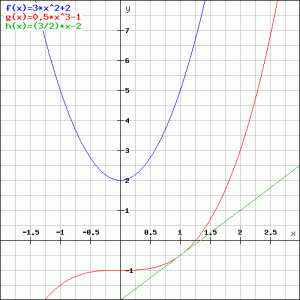
Jesus, that looks terrible, and is not at all representative of what he said. If you really try though, it does look a bit like someone skiing.
Thank you very much to everyone who contributed. Apologies if I’ve mangled your fine words.
* To preserve anonymity, all females have been named after members of Norway women’s national handball team.
** To preserve anonymity, all males have been named after characters in Weekend at Bernie’s.





 Pitching the World